What is prompt monitoring? Measuring your brand inside AI answers.
More and more buying decisions start with a question to an AI assistant instead of a search box. Prompt monitoring is how you find out what those assistants say when the question touches your market, and whether your brand appears in the answer at all.
What does prompt monitoring actually mean?
Prompt monitoring means asking AI assistants the questions your potential customers ask, systematically and repeatedly, and recording what comes back. Instead of tracking where a page ranks for a keyword, you track whether ChatGPT, Claude, Perplexity or Gemini mention your brand when someone asks for a recommendation, a comparison or an explanation in your category.
The unit of measurement changes with the medium. Classic search gave you a results page with ten positions and a long tail below. A generative assistant gives you one answer. There is no position four. Either your brand is part of the answer, or it is invisible for that question, in that moment, on that assistant.
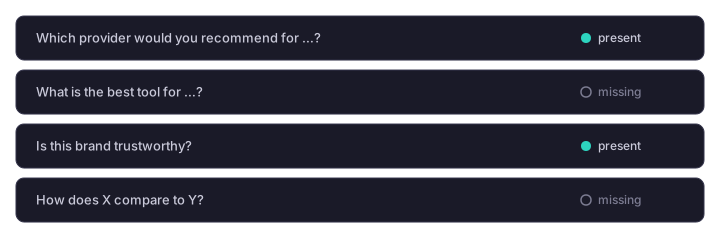
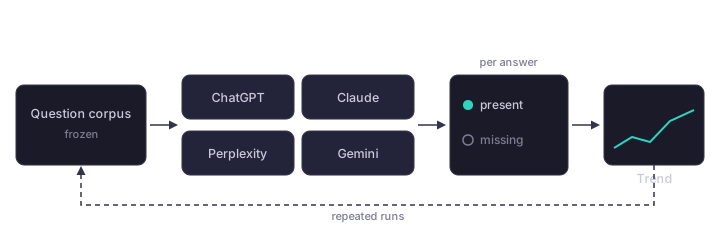
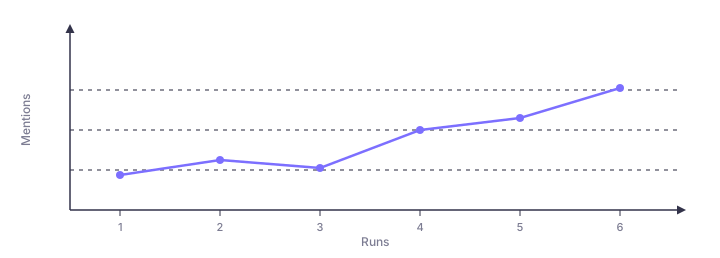
A single prompt tells you almost nothing, because generated answers vary between runs, phrasings and model versions. Prompt monitoring turns the anecdote into a measurement: many questions, several assistants, repeated runs. Across that grid, patterns become stable enough to act on.
Why doesn't this show up in your analytics?
Web analytics counts what happens on your site: sessions, pageviews, conversions. An AI answer happens somewhere else entirely. The assistant composes its response on someone else's infrastructure, and if the user never clicks through to you, your analytics records nothing. Not a lost visit, not a lost deal. Simply nothing.
Server logs help a little. You can see AI crawlers fetching your pages, and that is worth tracking. But a bot reading your page and an assistant recommending your brand are two different events. The first tells you your content is being ingested. The second tells you what buyers actually hear. Between them sits a blind spot that nothing in a typical analytics stack covers.
Prompt monitoring closes that gap from the outside in. It does not wait for signals to arrive. It asks the questions itself and inspects the answers.
How does prompt monitoring work in practice?
Everything starts with the question corpus, and this is where most setups go wrong. Generic keyword lists produce generic findings. The questions need to sound like your actual buyers: the wording from support tickets, the doubts a first-time customer has, the comparisons your sales conversations keep circling back to.
In Klariton, for example, the corpus is generated from your own customer questions, your personas and your brand core. Nothing runs until you have reviewed the questions and explicitly frozen the corpus. The freeze is not bureaucracy. If the questions drift from week to week, your trend lines compare apples to oranges and become decoration.
Once frozen, the corpus runs against ChatGPT, Claude, Perplexity and Gemini. Because every question is a real model call, measurement has a real price. A serious tool tells you what a run will cost before you start it and enforces a budget cap per run, so the measurement cannot quietly outgrow its value.
Which metrics matter in prompt monitoring?
Raw answers are interesting for an afternoon. Metrics are what you can steer by. Four are worth watching:
Presence. Across the whole corpus, how often does your brand appear in the answers at all? This is the baseline everything else builds on.
Share of voice. Your share of provider citations across all answers. If the assistants cite vendors forty times and you are four of those citations, you hold ten percent of the conversation.
Recommendation risk. The uncomfortable one: which competitors get recommended for questions where you should appear? It turns a vague worry into a named list.
Content opportunities. Questions where the assistants find thin or no material, each with a score, so you know which gap to close first instead of guessing.
A fifth signal comes from your own server: agentic reach. Bot-read tracking shows which AI bots actually read your pages. It connects the content work back to the answer layer.
How does prompt monitoring compare to rank tracking?
It does not replace your SEO reporting. It sits next to it and answers a different question:
Rank tracking | Prompt monitoring | |
|---|---|---|
Surface | Search results page | Generated answer |
Unit | Position for a keyword | Presence in the answer |
Competitive view | Who ranks above you | Who gets cited instead of you |
Signal | Position changes | Share of voice, recommendation risk |
Coverage | Keywords you selected | Questions your customers actually ask |
If your market still lives entirely in classic search, rank tracking alone may carry you for a while. The moment your buyers start asking assistants for shortlists, the right-hand column is where decisions are made.
How do you get started without overcommitting?
You do not need a big program to learn something useful. A small corpus of real questions, frozen and run on a steady rhythm, beats a sprawling list you keep editing. Read the first results for two things only: where competitors are recommended in your place, and which content gaps carry the highest score. Fix one or two, run again, compare.
And check the boring parts before you commit: where the data is processed and what happens to customer questions. Klariton runs on EU hosting and routes every AI call through a pseudonymization gateway, so personal details from real customer questions never reach the model providers.
Frequently asked questions
Ask your question about Klariton.
Grounded in Klariton’s own knowledge, cited rather than invented.
Klariton is an Answer Engine Optimization platform. It adds to your existing shop or website without replacing anything or migrating data. Your own knowledge becomes verified, source-based answers (BIQs) that AI assistants and your visitors use directly.
Product copy, FAQs, spec sheets, your CMS or shop catalog. Klariton processes your material read-only and turns it into cited answers. Your data is never used for model training.
All AI calls run EU-hosted. Personal data is pseudonymized before every call. Klariton reads your sources read-only and stores no plain-text customer data.
Every answer is source-backed and passes a review gate. Nothing is published unchecked. Safe Guard continuously watches published answers against your material and flags outdated or weak claims.
No. Klariton integrates with your existing site, with no platform switch or migration. One embed is enough, and your CMS stays the source of truth.
Plans scale with touchpoints and answer volume. The AI visibility check is free and needs no sign-up. For everything else, just talk to us.
How visible is your brand to AI?
The free AI visibility check shows you in under a minute how AI assistants see your shop today.